


Exclusive Deals & Trending Items



MMTC-PAMP Sukh Samridhi Series Laxmi Ganesh Silver Coloured Coin in Temple Shape of 100 Gram in 999.9 Purity / Fineness
Shop NowHave you ever thought about why gold consumption is so big in India? Its history with gold goes back to the Indus Valley Civilization. This makes India’s story with gold truly interesting.
Over time, India’s love for gold buying has grown. Today, it’s at the top in the gold consumption ranking. Knowing this history helps us understand India’s gold buying trends.
Key Takeaways
- India’s gold consumption has a rich history spanning 5000 years.
- The country’s affinity for gold is deeply rooted in its cultural heritage.
- India’s gold consumption ranking is influenced by its economic and cultural factors.
- Understanding gold buying trends is essential to grasping India’s gold consumption.
- India’s gold consumption history is a fascinating tale of evolution and growth.
India’s Golden Crown: Current Status as the World’s Largest Gold Consumer
India has become the leading gold buyer worldwide. Its gold demand greatly affects global markets. This demand is shaped by culture, economy, and history.
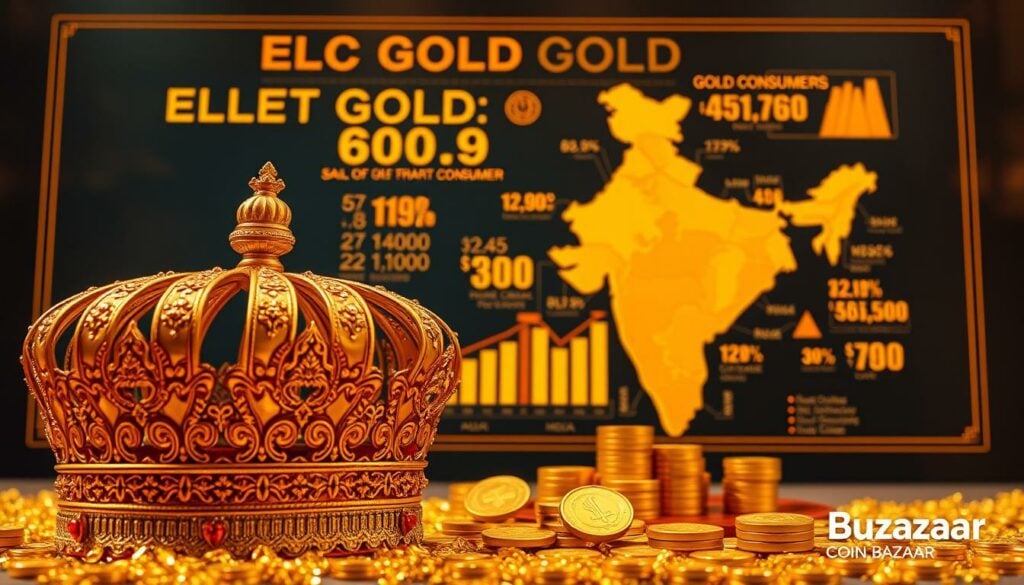
Modern Consumption Statistics and Global Rankings
India buys between 400-800 tons of gold each year. This makes it the top gold consumer worldwide. The World Gold Council says jewelry, investment, and coins drive this demand.
| Year | Gold Consumption (tons) | Global Ranking |
|---|---|---|
| 2022 | 612 | 1st |
| 2021 | 754 | 1st |
| 2020 | 421 | 1st |
Factors Behind India’s Dominance in Gold Markets
Several factors make India the biggest gold consumer country. Gold’s cultural value, in jewelry and as an investment, is key. Economic factors like fighting inflation and saving in rural areas also boost demand.
Traditions like gifting gold at weddings and festivals also increase consumption.
Ancient Foundations: Gold in the Indus Valley Civilization (3000-1500 BCE)
Did you know India’s love for gold started with the Indus Valley Civilization? This era, known for its smart cities and fine crafts, loved gold. They used it to make beautiful jewelry and decorations.
Archaeological Discoveries of Early Gold Artifacts
Archaeologists have found many gold items in Indus Valley sites. They found beads, earrings, and pendants that show the people’s skill. These finds show gold was important in their lives and rituals.
- Gold jewelry in the tombs of the rich shows a clear social order.
- Gold ornaments with detailed designs show the people’s technical skill.
- Gold in different forms suggests it was used for more than just decoration.
Trade Networks and Gold Acquisition Methods
The Indus Valley Civilization was connected to a wide trade network. This network went from modern-day Afghanistan to Egypt. It helped trade goods, including gold.
- They traded gold with areas known for their gold mines.
- They might have mined gold from river beds.
- They could have also imported gold from places like Afghanistan.
This early gold trade shaped the Indus Valley Civilization’s economy. It also made gold very important in Indian culture. Today, India is one of the biggest gold consumers.
Vedic Gold: Religious and Cultural Significance (1500-500 BCE)
Exploring the Vedic era, we see gold’s deep role in religious and cultural life. Gold’s importance was huge, key in spiritual practices and cultural traditions.
Gold References in Ancient Texts and Scriptures
The Vedic texts, like the Rigveda, are full of gold references. Gold was seen as more than a metal; it was a symbol of purity, prosperity, and divine favor. The Rigveda talks about gold in rituals and ceremonies, showing its sacred value.
Gold’s role in Vedic culture is clear from these texts. It was central to their religious and cultural practices.
Some key points about gold in ancient texts are:
- The use of gold in sacred rituals and ceremonies
- Descriptions of gold as a symbol of purity and divine favor
- References to gold ornaments and their significance in Vedic society
Early Ritualistic and Ceremonial Uses
Gold was used a lot in rituals and ceremonies in the Vedic period. It was not just for ornaments; gold made ritual objects and offerings to gods. Its use showed gold’s big role in religious practices, linking the material and spiritual worlds.
The early uses of gold in rituals included:
- Creating ritualistic objects for ceremonies
- Using gold in offerings to deities
- Employing gold ornaments in sacred rituals
Today, India is the world’s largest gold consumer. Its cultural practices have roots in ancient traditions. Understanding gold’s role in Vedic times helps us see why it’s so important in Indian culture and religion. This is why India is at the top in gold consumption globally.
Imperial Treasuries: Gold During Classical Indian Empires (321 BCE-550 CE)
Gold was key in ancient Indian empires, used for both money and art. The Mauryan and Gupta dynasties stood out, using gold widely in their currency and art.
Mauryan Gold Economy and Currency Systems
The Mauryan empire ruled from 321 BCE to 185 BCE. They built a strong gold economy. Gold coins were minted and used as currency, helping trade and commerce grow.
Gold in currency showed the empire’s wealth and stability. It made transactions easier and boosted trade.
Gupta Dynasty’s Golden Age of Artistry
The Gupta dynasty, known as India’s “Golden Age,” was a time of great art and culture. Intricately designed gold jewelry and ornaments showed wealth and status. Artisans of the Gupta period were famous for their gold work.
Their gold pieces were beautiful and showed advanced skills. These pieces are admired today for their beauty and craftsmanship.
India’s love for gold, as a top gold consumer worldwide, comes from these traditions. The Mauryan and Gupta empires’ legacy shapes India’s gold use, making it a big player in the global market.
Medieval Gold Traditions: Sultanate and Mughal Influences (1206-1857 CE)
India, the biggest gold consumer country, has a rich history with gold. This history was shaped by the Sultanate and Mughal influences. From 1206 to 1857 CE, gold traditions evolved greatly. This was thanks to royal support and the growth of local jewelry styles.
Royal Patronage and Court Goldsmithing Traditions
The Sultanate and Mughal eras saw a lot of support for goldsmithing. Court goldsmiths were very skilled. They made jewelry that was stunning and showed wealth and status.
The Mughal emperors loved gold and precious stones. They often asked for elaborate gold ornaments.
Some key features of Mughal goldsmithing include:
- Use of high-quality gold
- Incorporation of precious stones like diamonds and rubies
- Intricate designs and filigree work
Evolution of Regional Jewelry Styles and Techniques
During this time, jewelry styles in different regions started to change. This was due to local cultures and new techniques from Central Asia and Persia. People liked heavy, ornate jewelry that was passed down through generations.
| Region | Jewelry Style | Notable Features |
|---|---|---|
| North India | Mughal-inspired | Heavy gold ornaments, intricat designs |
| South India | Temple jewelry | Influence of Dravidian architecture, use of motifs |
| West India | Kundan and Meenakari | Use of glass and enamel work, vibrant colors |
Today, we can see the legacy of these styles in modern Indian jewelry. It shows the rich cultural heritage of India.
Colonial Transformations: Gold Under British Rule (1858-1947)
During British rule, India’s gold economy went through big changes. The British brought in new economic rules that changed how gold was used and traded in India.
British Economic Policies Affecting Gold Markets
The British colonial government made several economic rules that deeply impacted India’s gold markets. Some key policies included:
- They made the British currency the standard, changing how gold was used for trade.
- They put limits on gold imports and exports, making gold harder to find in the market.
- They taxed and took resources, leading to shifts in how gold was used.
These rules didn’t just change the gold market. They also had big effects on India’s economy, affecting its place in the global gold market.
Indian Resistance Through Gold Hoarding
Indians found ways to resist British rules by hoarding gold. Hoarding gold was a way to keep wealth safe and protect against economic risks.
This was common among rural people who couldn’t use banks. Hoarding gold helped them keep their economic security despite colonial exploitation.
Key aspects of Indian resistance through gold hoarding included:
- Keeping wealth in gold ornaments and coins.
- Protecting against inflation and economic instability caused by British policies.
- Keeping economic control despite colonial rule.
India’s tradition of gold hoarding during British rule helped it become one of the top gold consumers.
Post-Independence Challenges: Gold Control Era (1947-1990)
When India became independent in 1947, its gold market faced new challenges. The government wanted to save foreign exchange, so it put strict controls on gold imports.
Government Restrictions and the Gold Control Act
In 1968, the government passed the Gold Control Act. It aimed to control gold use and cut down imports. This act limited gold in jewelry and ornaments, trying to reduce imports.
These rules directly affected you, limiting your gold purchases and ownership. The Gold Control Act significantly reduced official gold imports. But, it also sparked a black market for gold.
| Year | Official Gold Imports | Black Market Gold Imports |
|---|---|---|
| 1968 | 100 tonnes | 50 tonnes |
| 1970 | 80 tonnes | 70 tonnes |
| 1975 | 60 tonnes | 100 tonnes |
Black Market Development and Smuggling Networks
The Gold Control Act led to a booming black market for gold. Smuggling networks grew to meet the demand for gold, despite government efforts. You might have known the risks of buying gold on the black market, but the demand kept rising.
“The Gold Control Act, while aimed at conserving foreign exchange, inadvertently led to the growth of a black market, which had far-reaching consequences for India’s gold economy.”
The black market for gold thrived until the 1990s, when gold imports were liberalized. As the world’s largest gold consumer, India’s demand for gold was too strong to be stopped by government rules alone.
Liberalization and Growth: How India Emerged as the World’s Largest Gold Consumer
India’s economic reforms in the 1990s changed everything. They made India the top gold consumer in the world. This change wasn’t just about money; it also changed how people bought and used gold.
1990s Economic Reforms and Gold Import Liberalization
The 1990s were a big time for India’s economy. The country started to open up, changing its economy a lot. Gold was one area that saw big changes.
Before the 1990s, India had strict rules on gold imports. This led to a big black market. But in 1993, the rules changed. Now, people could buy gold legally, making smuggling less common.
This change had a big effect. More gold was imported legally, and the market became more regulated. This helped the gold market grow a lot.
Explosion in Demand and Consumption Patterns
Thanks to the new rules, India’s gold use went up a lot. It became the top gold consumer worldwide. Gold is very important in Indian culture, like in weddings and festivals.
With more gold available and incomes rising, demand grew. The middle class in India also played a big role in this.
| Year | Gold Consumption (Tonnes) | Percentage Change |
|---|---|---|
| 1990 | 250 | – |
| 1995 | 800 | +220% |
| 2000 | 850 | +6.25% |
The table shows how much gold use went up after the reforms. People started buying gold not just for jewelry but also as an investment.
In short, India became the world’s largest gold consumer because of the 1990s reforms. Knowing about these changes helps us understand India’s gold market better.
Cultural Pillars: Gold in Indian Traditions and Ceremonies
In India, gold is more than just a valuable metal. It’s a key part of the culture. For ages, gold has been important in many Indian traditions and ceremonies. It stands for wealth, prosperity, and luck.
Wedding Gold: Streedhan and Dowry Practices
In Indian weddings, gold is a must-have for the bride’s dowry, called Streedhan. It’s given by the bride’s family to her, showing wealth and safety. The amount and quality of gold vary by region and community.
India, being the biggest gold consumer country, sees a big rise in gold demand during weddings.
| Region | Average Gold Given (in grams) | Common Purity |
|---|---|---|
| South India | 50-100 | 22k |
| North India | 100-200 | 22k |
| East India | 20-50 | 22k |
Festival Gold: Dhanteras, Akshaya Tritiya, and Religious Gifting
Gold is also key during Indian festivals. Dhanteras and Akshaya Tritiya are lucky days for buying gold. People buy gold coins, bars, or jewelry, increasing gold use.
India is among the countries that consume the most gold. A lot of this happens during festivals.
These traditions show gold’s big role in Indian culture. They also highlight India’s place as a major gold user worldwide.
Economic Security: Gold as India’s Financial Safety Net
In India, gold has long been a financial safety net. It provides economic security when times are uncertain. Gold’s role in the country’s economy is key because it acts as a shield against financial instability.
Rural Banking Alternatives and Liquid Assets
In rural areas, where banking is scarce, gold is a vital liquid asset. You can pawn or sell gold to meet urgent needs. This is vital where credit is hard to get and cash flow is unpredictable.
Gold also serves as a savings option in these areas. Its value is well-known, and it’s more liquid than other savings. This makes it a reliable choice for rural households.
Inflation Hedging and Wealth Preservation
Gold is a hedge against inflation, as its value goes up when costs rise. Investing in gold helps protect wealth. India’s demand for gold is high because it helps preserve wealth against inflation.
Gold is also a stable store of value. It’s not affected by the volatility that can hit other investments. This makes it a good choice for long-term wealth preservation.
Regional Gold Diversity: State-Specific Traditions
India’s regions have their own gold traditions. These are shaped by local cultures and histories. You can see this in how gold is used and celebrated in different states.
South Indian Gold Culture: Kerala and Tamil Nadu
In South India, gold is a big part of daily life and culture. Kerala’s traditional gold ornaments, like Thali and Mathi, are important in weddings and ceremonies. Tamil Nadu is famous for its detailed gold jewelry, often with temple motifs.
North and West Indian Gold Practices
In North and West India, gold traditions are different. Rajasthan is known for its intricately designed gold jewelry with precious stones. Gujarat is famous for Navratna jewelry, with nine precious stones in gold. These areas show a lot of diversity in gold craftsmanship.
Eastern Indian Gold Traditions and Tribal Jewelry
Eastern India, like Odisha and West Bengal, has its own gold traditions. Tribal communities here make distinctive gold jewelry that shows their culture. Gold is used in traditional clothes and at festivals, showing the region’s love for gold.
Exploring India’s gold culture shows its regional diversity. This diversity makes India one of the countries that consume the most gold. It highlights the country’s gold buying trends.
Modern Gold Ecosystem: Banking and Investment Innovations
The gold market in India is changing fast. This is thanks to government plans and new tech. As the biggest gold buyer globally, India is now using gold in new ways. It’s not just for jewelry anymore but also for financial tools.
Gold Monetization Schemes and Sovereign Gold Bonds
The Indian government has launched plans to make gold investments easier. The Sovereign Gold Bond (SGB) scheme lets people invest in gold bonds. These bonds are issued by the Reserve Bank of India.
The SGBs offer several perks:
- Earning interest on gold investments
- Avoiding the need for physical storage
- Reducing the risk associated with gold price volatility
These bonds can be traded on stock exchanges. This makes them liquid for investors. The SGB scheme has helped cut down on physical gold demand. It encourages people to invest in gold financially.
Digital Gold and New-Age Investment Platforms
Digital gold platforms are becoming a hit for investing in gold. They let users buy, sell, and store gold online. They can also get physical gold if they want. Companies like MMTC-PAMP and SafeGold offer these digital gold options. They make investing in gold easy and safe.
The benefits of digital gold are:
- Flexibility in investment amounts
- Easy storage and transfer
- Transparency in transactions
As India remains the top gold consumer worldwide, these new ideas will keep changing the gold market. They make gold more accessible and smart for financial investments.
Global Impact: India’s Influence on World Gold Markets
India is the world’s biggest gold consumer. Its impact on global gold markets is huge. Knowing this helps you understand the gold trade worldwide.
Price Sensitivity and Seasonal Demand Patterns
India’s gold demand changes global prices, more so during Diwali and Akshaya Tritiya. Gold prices go up during these times because of more demand. As the leading gold buyer, India’s patterns shape global gold prices.
The country’s large rural population sees gold as a safe investment. This demand is driven by culture and tradition, making it less affected by price changes.
International Trade Relationships and Import Policies
India’s gold import policies affect its international trade. As the biggest gold consumer country, India imports a lot to meet demand. This has led to efforts to make imports easier and cut down on smuggling.
India’s trade with gold-producing countries like Switzerland and South Africa is influenced by its import policies. The country’s ability to get good trade deals impacts the global gold market. This makes India a key player in international gold trade.
Conclusion: 5000 Years of Golden Heritage and Future Outlook
India’s love for gold goes back 5000 years. It’s a big part of the country’s culture, traditions, and economy. Gold has shaped India’s identity from ancient times to today.
India’s gold use has changed over time. It’s been influenced by history, culture, and the economy. Now, India leads the world in gold use, thanks to its strong demand during festivals and weddings.
As the biggest gold user, India’s demand affects global gold markets. Experts and investors keep an eye on India’s gold trends. With its deep love for gold, India will keep playing a big role in the global gold market.
India’s gold use is set to stay strong. This is because of its culture and economy. As India grows, its love for gold will continue to shape the global gold industry’s future.