




You might know how big emerging economies are getting. The BRICS grouping, with Brazil, Russia, India, China, and South Africa, leads this change.
The BRICS rhetoric talks about changing global finance and pushing for a more balanced world. When looking at international relations in BRICS, it’s key to know the difference between what they say and what they do.
This article will dive into BRICS policies and their effects on the world market. It aims to help you grasp the impact on your investments and the global economy.
Key Takeaways
- The BRICS grouping is redefining global economic dynamics.
- Understanding the difference between BRICS rhetoric and real policy is key.
- The BRICS nations are pushing for a more balanced world order.
- Market reactions to BRICS policies can be big.
- Keeping up with BRICS news is important for investors.
The Evolution of BRICS: From Economic Concept to Geopolitical Alliance
The BRICS grouping has changed a lot over time. It started as just an economic idea but now it’s a strong political alliance. Looking into BRICS’ history, you’ll see how it has grown in power and influence.
Origins and Initial Purpose of BRICS
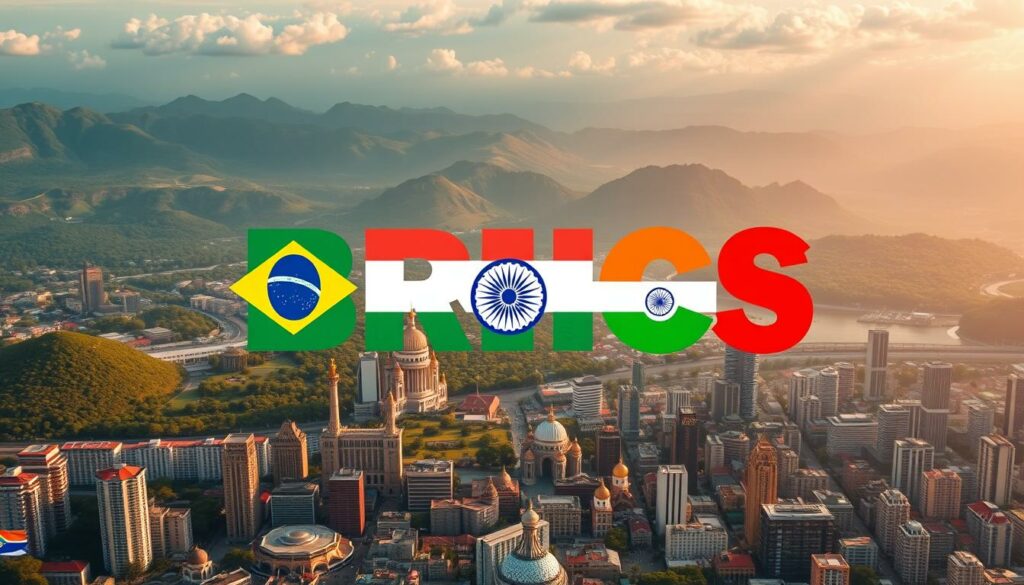
In 2001, economist Jim O’Neill at Goldman Sachs came up with the BRICS idea. He saw Brazil, Russia, India, and China as big players with lots of growth. The first goal was to work together on economic issues and find new investment chances.
The first BRIC summit was in 2009, starting their official partnership. In 2011, South Africa joined, making it BRICS.
Key Milestones in BRICS Development
BRICS has hit many important milestones. One big step was starting the New Development Bank (NDB) in 2015. It offers a new way to fund projects for growth and development.
The group has also worked hard to increase trade and investment among themselves. They set up the BRICS Contingent Reserve Arrangement (CRA) to help with financial stability. Plus, more countries are interested in joining this powerful group.
BRICS Rhetoric: Analyzing the Language of Multilateral Cooperation
Diplomatic talk in BRICS is key as it tackles global challenges. The words used in BRICS summits show what the alliance values and plans.
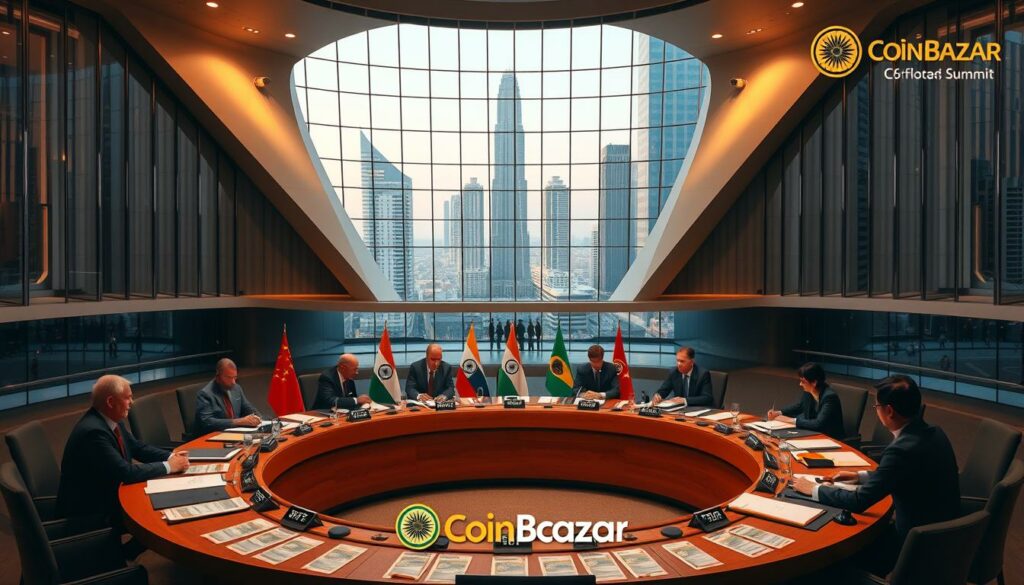
Common Themes in BRICS Official Communications
BRICS talks a lot about working together on the economy, financial stability, and growth. They push for more trade and investment among themselves. For example, the New Development Bank (NDB) helps fund projects in member countries.
Looking at recent BRICS summits, there’s a big push for more trade and investment among members. Here’s a table showing common themes and how often they appear:
| Theme | Frequency |
|---|---|
| Economic Cooperation | 85% |
| Sustainable Development | 75% |
| Financial Stability | 60% |
Symbolic vs. Substantive Messaging
BRICS talks big about working together and growth. But, it’s important to know the difference between words and actions. Words can show unity or support for ideas, but actions really make a difference.
For instance, talking about using less US dollars and more local currencies is a real step. It shows they’re serious about changing things. You can see how these changes affect money markets and trade.
The Current BRICS Landscape: Member Profiles and Power Dynamics
The BRICS alliance includes Brazil, Russia, India, China, and South Africa. Each country brings its own strengths to the table. This diversity helps BRICS face global challenges through global cooperation and support.
Brazil: Economic Challenges and Political Positioning
Brazil is the biggest economy in Latin America but faces economic and political issues. Despite these, its natural resources and large market are key to BRICS’ success.
Russia: Sanctions Impact and Strategic Objectives
Russia’s role in BRICS is shaped by its tensions with the West and economic sanctions. Yet, it’s a major energy supplier and plays a big part in BRICS’ goals.
India: Rising Influence and Diplomatic Priorities
India’s economy is growing fast, making it a key BRICS member. It aims to boost regional cooperation and support a more balanced world.
China: Economic Leadership and Regional Ambitions
China is the second-largest economy and drives BRICS forward. Its Belt and Road Initiative (BRI) is key to the group’s economic plans, promoting global cooperation.
South Africa: Continental Representative and Economic Gateway
South Africa’s BRICS membership highlights Africa’s economic growth. It opens doors for BRICS investments in Africa, boosting the continent’s development.
In summary, BRICS’ diverse members create a rich mix of geopolitical dynamics. Understanding these dynamics is key to seeing BRICS’ influence on global issues.
BRICS Expansion: Strategic Implications of New Membership
BRICS growth is more than just numbers. It’s a shift in global economic power. The addition of new countries changes how BRICS influences the world.
Recent Additions: Egypt, Ethiopia, Iran, Saudi Arabia, and UAE
BRICS has welcomed Egypt, Ethiopia, Iran, Saudi Arabia, and the UAE. These new members bring different views on economics and politics. This could make BRICS more important globally.
How Expansion Changes BRICS Dynamics
New members change BRICS in big ways. They affect the group’s economic strength and its views on the world.
Economic Weight Redistribution
New members like Saudi Arabia and the UAE add a lot to BRICS. They bring oil and money, changing the group’s economic picture.
| Country | GDP (nominal) | Main Economic Contribution |
|---|---|---|
| Egypt | $394 billion | Agriculture, Tourism |
| Ethiopia | $111 billion | Agriculture, Manufacturing |
| Iran | $388 billion | Oil and Gas, Industry |
Ideological Diversity Challenges
BRICS now faces the challenge of staying united. With different political and economic views, keeping everyone in line is hard.
As BRICS grows, understanding these changes is key. It helps in foreign policy analysis and seeing how BRICS affects the world.
Decoding BRICS Summit Declarations: Rhetoric vs. Actionable Commitments
BRICS summit declarations often promise a lot, but the real test is in action. As BRICS nations grow in global influence, it’s key to look beyond words. We must see what they actually do.
Evolution of Key Messaging Priorities
The messages from BRICS summits have changed a lot over time. This change mirrors the shifting world and the goals of its members. At first, they focused on working together economically. Now, they talk about climate change, digital economy, and global governance reform. This shows BRICS wants to tackle more than just money matters.
The 2023 summit was big on wanting a fairer global finance system. This shows BRICS is ready to challenge the current world order. Their words suggest they aim to influence global policies more.
Implementation Tracking of Summit Promises
It’s not just what BRICS says that matters, but what they do. Keeping track of their actions shows if they’re serious about their promises. For example, the New Development Bank (NDB) was a big step. It helps fund projects in member countries, showing BRICS can deliver.
But, there are hurdles to overcome. Things like domestic politics, world economy, and working together can slow things down. So, it’s important to keep checking on how BRICS is doing and where they can do better.
The Reality Gap: When BRICS Rhetoric Meets Policy Implementation
The BRICS group talks a lot about unity and cooperation. But how does this translate into real policy? The alliance, made up of Brazil, Russia, India, China, and South Africa, wants to work together more and change the global order. But, how well do they really do it?
The gap between what BRICS says and what they do is big. They sound united in their words. But, putting these words into action is hard, leading to a gap between what’s said and done.
Case Studies of Successful Policy Alignment
There are times when BRICS gets it right. For example, starting the New Development Bank (NDB) shows they mean business. The NDB helps fund projects in member countries, showing they can follow through on their promises.
| Year | Project | Country | Funding (USD) |
|---|---|---|---|
| 2016 | Renewable Energy Project | Brazil | 500 million |
| 2018 | Transport Infrastructure | India | 1 billion |
Instances of Divergence Between Words and Actions
Even with successes, BRICS sometimes doesn’t follow through. They talk a lot about climate change, but don’t always act. India’s handling of US trade pressures, as pointed out by Phapano Phasha, shows the challenges of staying united while dealing with global politics.
Why don’t they always match words with actions? It’s because of many reasons, like what’s best for their own countries and their own economies. Knowing these reasons helps us understand how well BRICS works together.
Economic Initiatives: From Bold Announcements to Practical Results
The BRICS group is growing, and its economic plans are key for cooperation among new economies. It helps keep economies stable and works together on projects.
The New Development Bank’s Lending Portfolio
The New Development Bank (NDB) plays a big role in BRICS’ economic plans. It has given over $30 billion for projects that help the environment and grow economies.
Intra-BRICS Trade Growth Analysis
Trade between BRICS countries has grown a lot. This is because they work together more to boost their economies. They are moving towards more balanced trade.
Sectors Benefiting Most from BRICS Cooperation
Renewable energy, transportation, and technology are big winners from BRICS cooperation. These areas get a lot of investment and projects, helping the region grow.
Persistent Trade Barriers Despite Rhetoric
Even with talk of better trade, BRICS countries face many trade barriers. Tariffs and other barriers slow down trade. This shows we need better ways to make trade easier.
| Sector | Investment (in billion USD) | Growth Rate (%) |
|---|---|---|
| Renewable Energy | 10.2 | 15 |
| Transportation Infrastructure | 8.5 | 12 |
| Technology | 5.8 | 20 |
De-Dollarization Efforts: Analyzing the Push for Monetary Independence
BRICS countries are leading the way in reducing their US dollar dependence. They aim for more monetary freedom and stable financial systems. A Politico report shows that Europe is also rethinking its role in global governance, similar to BRICS’ economic path.
Local Currency Settlement Mechanisms: Progress Report
BRICS nations have made big steps in using local currencies for transactions. This move cuts costs and lessens dollar risk. For example, China and Brazil have trade agreements in their own currencies, avoiding the US dollar.
Sergey Lavrov, Russia’s Foreign Minister, said, “Using national currencies in trade is key for us.”
Challenges to Creating a BRICS Reserve Currency
Creating a BRICS reserve currency is a tough task. It needs economic stability, coordination, and strong financial systems. Experts say it’s a complex challenge.
“The creation of a new reserve currency is a complex task that requires a high degree of economic integration and trust among the participating nations.”
Experts point out the big hurdles BRICS must face.
To move forward, BRICS must improve economic ties, strengthen banks, and use the New Development Bank. This could help create a BRICS reserve currency.
Market Knee-Jerks: How Financial Markets React to BRICS Announcements
Every BRICS summit brings the financial world to the edge of their seats. They watch for any changes in global economic trends. The BRICS countries, including Brazil, Russia, India, China, and South Africa, play a big role in shaping global policies. Their announcements can cause big changes in the market.
Currency Market Volatility Following BRICS Statements
BRICS statements can make currency markets jump. For example, talk about using less dollars or settling in local currencies can shake up exchange rates. Investors and traders keep a close eye on these changes, adjusting their plans as needed.
Commodity Price Movements in Response to BRICS Policies
BRICS policies also affect commodity prices. China’s plans, often discussed at BRICS summits, can change global demand for things like oil and metals. This, in turn, can change prices around the world.
| Commodity | Price Change Following BRICS Announcement |
|---|---|
| Oil | +2% |
| Gold | +1.5% |
| Copper | +3% |
Stock Market Performance of BRICS-Based Companies
Stocks of companies from BRICS countries can also be affected by summit news. Good news about working together or investing in infrastructure can make stocks go up. But bad or unclear news can make them go down.
If you’re an investor, it’s important to watch these changes closely. Knowing how BRICS news affects markets can help you make better investment choices.
India’s Strategic Leverage Within the BRICS Framework
The BRICS alliance is a big chance for India to improve its international relations and diplomatic discourse. As a key player, India can handle the complex world of global politics and economics.
India’s Unique Position Between East and West
India sits between the East and West, thanks to its geography and history. This spot makes India a key player in talks and cooperation among BRICS nations. India’s cultural diversity and growing economy also boost its role in BRICS.
Economic Opportunities for Indian Businesses in BRICS Markets
The BRICS group opens up big chances for Indian businesses. By using the BRICS framework, Indian companies can grow in member countries. They can enter new markets and find new resources.
Export Sectors with Growth Potentials
Indian businesses can look into several export areas with big growth chances in BRICS markets. These include:
- Textiles and apparel
- Pharmaceuticals
- Automotive components
- Information technology services
Investment Channels and Partnership Models
To make the most of these chances, Indian businesses can use different investment ways and partnership models. For example:
- Joint ventures with local companies
- Strategic partnerships with BRICS-based firms
- Investment in infrastructure projects
By using these tactics, Indian businesses can grow in BRICS markets. This helps India’s economy and boosts its standing in the alliance.
Competing Global Visions: BRICS Alternatives to Western Institutions
The rise of BRICS has brought a new era of competition in global governance. New institutions are emerging to counter Western influence. BRICS nations are challenging Western financial institutions as the global economy evolves.
BRICS countries want more autonomy and a more balanced world order. They are creating their own financial institutions, rivaling Western powers.
BRICS Payment System vs. SWIFT
The BRICS payment system is a key development. It aims to reduce dependence on SWIFT, dominated by Western countries. It seeks to make transactions faster, more secure, and cheaper for member nations.
| Feature | BRICS Payment System | SWIFT |
|---|---|---|
| Control | Decentralized, BRICS controlled | Centralized, Western dominated |
| Transaction Speed | Faster settlement times | Variable, often slower |
| Cost | Lower transaction fees | Higher fees due to intermediaries |
Development Financing Models: NDB vs. World Bank
The New Development Bank (NDB) is a significant alternative to the World Bank in development financing. It focuses on infrastructure and sustainable projects in BRICS countries.
The NDB and World Bank differ in governance and lending. The NDB offers flexible terms and focuses on projects that meet its member countries’ goals.
| Institution | Governance | Lending Focus |
|---|---|---|
| NDB | Equal voting rights among members | Infrastructure, sustainable development |
| World Bank | Weighted voting, Western influence | Broad development agenda |
As BRICS grows, its institutions will play a bigger role in global governance. This shift towards a more balanced world reflects a broader trend towards global cooperation and a reevaluation of existing dynamics.
Technology and Innovation: Collaborative Efforts Among BRICS Nations
BRICS countries are teaming up to lead in technology and innovation. They see how important tech is for growing their economies. This partnership is key to their success.
Digital Economy Initiatives and Standards Development
BRICS nations are building strong digital economies together. They’re improving digital infrastructure and boosting e-commerce. They also aim to create common digital transaction standards.
This will help them trade and invest across borders more easily. They’re focusing on digital payments, better cybersecurity, and new tech like AI and blockchain.
Research Partnerships and Knowledge Transfer Programs
Research and knowledge sharing are big parts of BRICS tech efforts. Countries are working on joint projects, sharing skills, and setting up innovation centers. This helps them grow technologically.
These steps also encourage innovation and business spirit. By working together, BRICS can grow faster and become more stable economically.
Climate Change and Sustainability: Collective Commitments and Individual Actions
BRICS countries are key players in the fight against climate change and for sustainability. Their efforts show that protecting the environment and growing their economies go hand in hand. This is a big step towards a better future.
These nations are working together to tackle climate change. They aim to cut down on carbon emissions and support renewable energy. Their goal is to make their economies more sustainable.
Green Energy Investment Trends
BRICS countries are moving towards green energy fast. They’re investing a lot in solar and wind power. China leads in solar, while India is making big strides in wind energy. This move helps reduce carbon emissions and boosts their economies.
The trend towards green energy is set to grow. Thanks to cheaper technology and supportive policies, it’s becoming more affordable. Green energy will be a big part of BRICS’ energy future, helping fight climate change worldwide.
Reconciling Development Needs with Environmental Goals
BRICS nations face a big challenge: meeting their economic goals while protecting the environment. They need to grow their economies and reduce poverty without harming the planet. The New Development Bank (NDB) helps fund projects that meet both economic and environmental needs.
By choosing sustainable development, BRICS countries can meet their economic targets and help the planet. This approach benefits them and supports global efforts to fight climate change and promote sustainability.
How You Can Navigate BRICS-Influenced Market Movements
BRICS is changing the world economy. It’s key for investors to know how it affects markets. The alliance’s actions can sway market trends, so staying updated is vital.
Investment Strategies for Indian Investors
Indian investors can profit from BRICS by spreading their investments. Look into areas that BRICS will support, like:
- Renewable energy projects
- Infrastructure development
- Technology and innovation
Key Economic Indicators to Monitor After BRICS Announcements
After BRICS news, watch these economic signs for market clues:
- Currency exchange rates
- Commodity prices
- Stock market performance of BRICS-based companies
Short-Term Trading Opportunities
Indian investors can grab quick trading wins by watching BRICS news. Be ready to move fast when market events happen.
Long-Term Portfolio Positioning
For lasting gains, align your portfolio with BRICS’ plans. This might mean investing in emerging sectors or companies set to grow with BRICS.
Future Trajectories: Emerging Trends in BRICS Cooperation
The BRICS alliance is on the verge of a new chapter. This is thanks to changing geopolitical dynamics and diplomatic discourse. As the world changes, BRICS countries are updating their plans to tackle new challenges and chances.
Potential New Areas of Collaboration
BRICS is looking into new ways to work together, focusing on tech and innovation. They’re starting digital economy initiatives and standards development to boost economic ties. For example, the New Development Bank (NDB) helps fund projects, supports sustainable growth, and backs green energy.
Challenges That Could Reshape the Alliance
BRICS also faces hurdles that could change the alliance. These include diverging economic interests among members and the need for a unified strategic framework. Global events, like economic sanctions and tensions, could also affect BRICS cooperation.
By grasping these trends and challenges, you can better understand BRICS cooperation. This knowledge helps you navigate its role in global governance.
Conclusion: Making Sense of BRICS Rhetoric in a Changing World Order
The world is changing fast, and it’s key to understand the role of emerging economies. The BRICS alliance, made up of Brazil, Russia, India, China, and South Africa, leads this change. They aim to create a more balanced world.
You now know more about BRICS and its impact on the world. The BRICS nations have worked hard to boost economic ties. They’ve started the New Development Bank and local currency deals. But, they face the challenge of turning words into action.
With global leadership weakening, as Politico points out, emerging economies are more important than ever. They will help solve big issues like climate change and economic gaps. This shows that working together is essential for our future.
The BRICS alliance will keep being a big player in this effort. Knowing how they work is vital for investors, policymakers, and anyone interested in global cooperation.